Abstract
Distributed systems assume a deterministic world.
For decades, we coordinated machines across unreliable networks. We formalized consensus, replication, causality, consistency, fault tolerance, recovery, and control. We parameterized timing. We parameterized communication. We parameterized failure.
Yet one axiom remained unchallenged:
Correct participants execute protocol-specified behavior with stable, externally defined semantics.
This assumption enabled the classical era of distributed systems.
It is no longer sufficient.
Autonomous reasoning engines now penetrate cloud control planes, software delivery pipelines, incident response systems, financial platforms, energy grids, defense environments, and sovereign AI infrastructure. These participants do not merely execute instructions. They interpret goals, retrieve context, synthesize plans, generate code, explain decisions, and propose mutations to live systems.
They may be functional, authenticated, and semantically correct—yet produce entirely divergent execution traces, rationales, plans, and internal representations.
This is the post-deterministic break.
We introduce Post-Deterministic Distributed Systems (PDDS): the research and engineering discipline for achieving assured coordination, safety, and verifiable execution where deterministic services, stochastic models, AI agents, policy engines, and human-machine actors coexist.
Classical distributed systems are not obsolete.
They represent the deterministic limit case.
The next era demands a broader foundation.
I. The Boundary of the Deterministic Axiom
A central abstraction in classical distributed computing is the correct node.
A correct node follows the protocol.
A correct node applies the specified transition.
A correct node turns ordered inputs into predictable outputs.
This abstraction built modern infrastructure.
State Machine Replication, Paxos, Raft, distributed transactions, Byzantine fault tolerance, and cloud control planes all rely on this premise: correct participants exhibit bounded, predictable behavior.
But autonomous agents defy this boundary.
When large language models and autonomous agents interpret goals and propose actions, the core assumptions of State Machine Replication collapse.
Two agents observing the same telemetry spike may reach identical conclusions via divergent reasoning paths: one summarizes logs, another inspects metrics, a third retrieves deployment history. Their execution traces diverge, yet their proposed actions remain semantically equivalent.
Classical theory classifies crashed nodes.
It classifies slow nodes.
It classifies partitioned nodes.
It classifies Byzantine nodes.
But it cannot classify a participant that is:
alive, authorized, non-identical, and semantically correct.
That is the gap.
PDDS begins at this boundary.
II. From State Agreement to Semantic Coherence
The classical question:
Do the nodes agree on state?
The post-deterministic question:
Do the participants preserve intent, evidence, policy, and admissible behavior?
This does not reject consensus; it expands what we must certify before execution.
In deterministic systems, correctness reduces to transition equivalence:
identical inputs yield identical state transitions and outputs.
In post-deterministic systems, correctness must accommodate a broader class of admissible outcomes:
divergent reasoning traces, intermediate representations, and plans that yield equivalent operational meaning under declared intent, evidence, and policy.
We must move from strict deterministic transition equivalence to assured semantic coherence.
Systems must certify not only what a participant produced, but whether the outcome is admissible.
Protocols must natively express:
- intent;
- evidence;
- provenance;
- policy;
- behavioral envelopes;
- semantic equivalence;
- correlated reasoning failure;
- authority boundaries;
- execution constraints.
The credential is no longer the unit of trust.
Trust resides in the verified path from intent to execution.
III. The Post-Deterministic Framework
PDDS is the engineering discipline of building systems when deterministic execution is no longer the default.
We do not claim deterministic systems will disappear.
We claim something more precise:
deterministic participants represent the zero-ambiguity limit of a broader, stochastic participant model.
A traditional service executing a database update has exactly one admissible transition for a given state and input.
An autonomous agent deriving a remediation plan has many admissible paths, diverse explanations, and syntactically unique outputs.
The system must not force every participant into a deterministic mold.
The system must govern the space of semantically admissible coordination.
That is the shift.
Post-deterministic infrastructure coordinates deterministic code and stochastic reasoning agents under unified rules of engagement. By establishing clear protocol, cryptographic, and semantic boundaries, we safely govern high-variance participants alongside legacy systems. We must make autonomy governable, inference auditable, intent durable, and execution certifiable.
Without this foundation, agentic infrastructure remains a fragile collection of wrappers around probabilistic engines.
With it, autonomous agents become trustworthy participants in mission-critical infrastructure.
IV. Five Architectural Pillars of PDDS
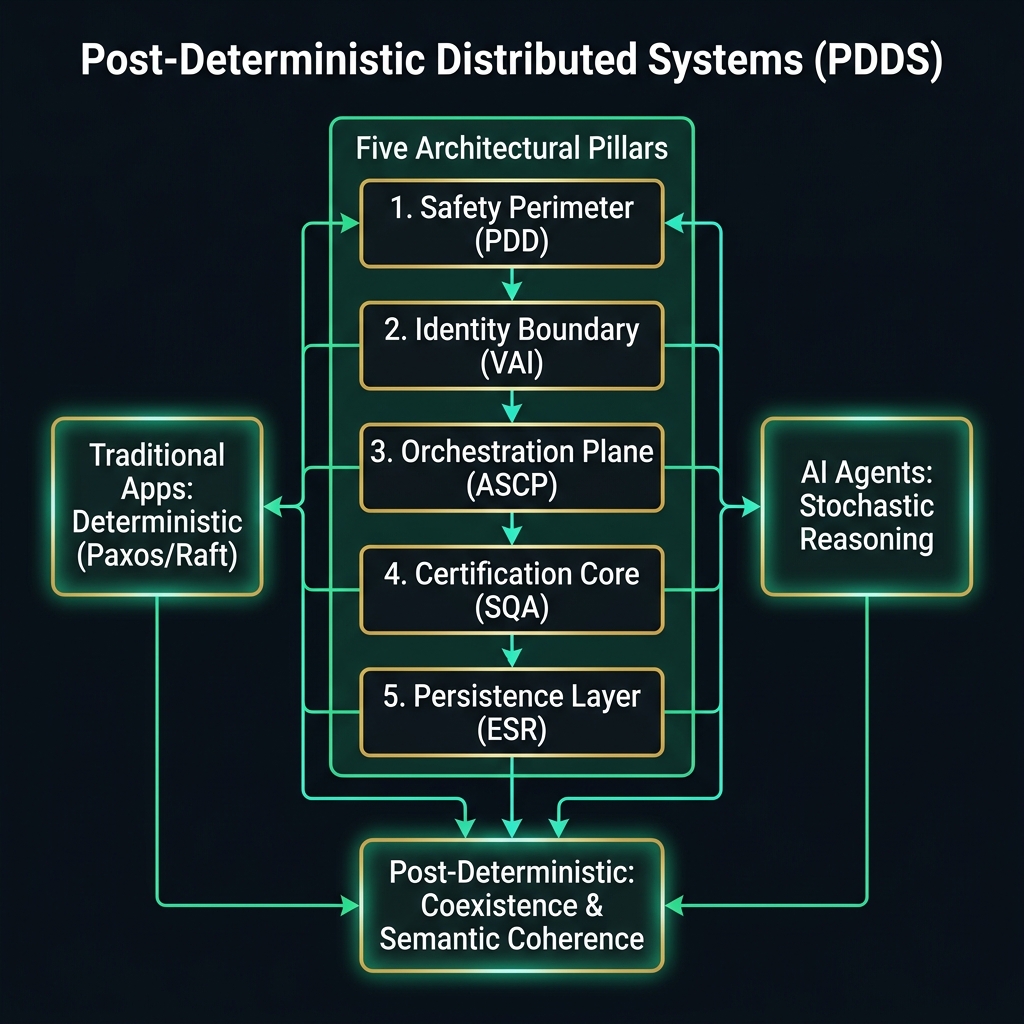
1. Safety Perimeter: Protocol-Driven Development
In the classical era, we trusted code because humans wrote, reviewed, and compiled it.
In the post-deterministic era, autonomous loops generate, modify, and execute code dynamically.
This shifts the safety boundary.
Protocol-Driven Development moves the focus from code construction to semantic admissibility.
We do not trust agents because their reasoning sounds plausible.
We trust them only when their outputs satisfy machine-enforceable protocols.
The protocol defines the safety perimeter, establishing the rules that all subsequent layers must enforce.
2. Identity Boundary: Verifiable Agentic Infrastructure
Inside this protocol perimeter, static identity is insufficient.
Classical IAM asks:
Does this identity hold the credential?
Post-deterministic infrastructure asks:
Is this proposed action authorized, delegated, and safe within the current system state?
Credentials alone cannot prevent hallucinations, overreach, or context misinterpretation.
Verifiable Agentic Infrastructure replaces static credentials with intent-based authorization using ephemeral delegation chains.
Agents propose.
Protocols verify.
Evidence is preserved.
We delegate execution authority only after proving semantic admissibility.
3. Orchestration Plane: Autonomous State Control Planes
Once authority is delegated, the system must orchestrate execution without losing control.
Traditional schedulers allocate hardware resources; post-deterministic orchestrators provide Intent-Preserving Orchestration.
As autonomous processes run over long horizons, they face partial context and unstable environments. The critical threat is no longer simple node failure, but intent drift—the divergence between the initial goal and the eventual action.
Autonomous State Control Planes isolate high-variance reasoning from direct state mutation.
They separate reasoning from execution.
They preserve intent across asynchronous time boundaries.
They isolate high-variance reasoning from irreversible mutation.
They contain autonomous infrastructure within governed operational boundaries.
The control plane is no longer merely resource-aware; it is intent-aware.
4. Certification Core: Semantic Quorum Assurance
To validate execution within these control planes, we must achieve agreement across stochastic participants.
Classical consensus verified bitwise agreement; the post-deterministic era demands collective certification of meaning.
Semantic Quorum Assurance replaces classical consensus with Collective Certification.
Rather than comparing raw string outputs, the quorum evaluates:
- Did independent participants converge on semantically equivalent actions?
- Did they utilize diverse reasoning models to avoid correlated intelligence failures?
- Does the derived evidence justify the proposed state transition?
- Does the action comply with the governing policy and original intent?
This is not majority voting over text.
It is the collective certification of intent, evidence, and behavior before any state mutation is committed.
5. The Persistence Layer: Epistemic State Replication
Finally, the certified outcomes of these quorums must be persisted reliably without destroying the cognitive diversity of the network.
Classical databases assume deterministic execution and enforce strict data visibility.
Post-deterministic infrastructure must replicate knowledge states derived from probabilistic reasoning paths.
In a network of reasoning agents, replicas may hold different local contexts—divergent retrieved documents, compressed summaries, or token boundaries—yet reach semantically equivalent conclusions.
Forcing bitwise linearizability across replicas destroys cognitive diversity and halts execution.
Epistemic State Replication solves this by shifting the persistence model from data visibility to knowledge visibility.
We redefine ACID properties for cognitive transactions, replacing bitwise linearizability with Semantic Linearizability and Eventual Coherence.
This model establishes how belief states propagate across nodes.
Crucially, it enables verifiable semantic rollbacks: when an autonomous loop must be reversed, the system prunes the belief lineage without triggering context amnesia.
V. The Operational Imperative
The post-deterministic era is not a future speculation; it is active production.
AI agents now drive terminals, deployment queues, CI/CD pipelines, cloud APIs, incident response systems, financial platforms, and national digital infrastructure.
We no longer debate whether autonomous agents will enter critical paths.
They are already there.
The question is whether we admit them via prompts, wrappers, and hope—or govern them through a rigorous theory of coordination.
PDDS provides that theory.
Our objective is clear:
Make autonomous infrastructure safe to trust, auditable to govern, and rigorous to build upon.
By maintaining an immutable Intent-to-Execution Evidence Chain (IEEC) and validating collective reasoning through Semantic Quorum Assurance (SQA), we enable organizations to confidently govern autonomous remediation loops and agent-proposed rollbacks across enterprise fleets.
The classical era taught machines to agree on state.
The post-deterministic era must teach heterogeneous participants to preserve intent.
This is the new foundation.
VI. Call to the Field
We need new models.
We need new protocols.
We need new definitions of correctness.
We need new failure classes for hallucination, semantic drift, correlated reasoning, intent loss, evidence fabrication, unsafe delegation, and policy-violating autonomy.
We need a distributed systems theory that integrates deterministic services, stochastic models, autonomous agents, policy engines, and human-machine actors into a single unified framework.
We need infrastructure where governance is not an afterthought, but a first-class citizen.
This is the research agenda of PDDS.
The deterministic era delivered reliable distributed computation.
The post-deterministic era must deliver trustworthy autonomous infrastructure.
Let us build it.