Vision 2030 & Sovereignty
Directly maps the ASCP framework to concrete Vision 2030 initiatives, including NEOM smart-city operations, SDAIA data platforms, and DGA public-sector automation.
Sovereign Leadership / حكمة سيادية
الحزم أبو العزم، ولا حزم إلا بتدبير
"Firmness is the father of resolve, and there is no firmness without deliberate governance."
Saudi Arabia is a useful reference case for sovereign AI infrastructure. Its national transformation agenda connects digital government, infrastructure development, smart-city programs, industrial modernization, and large-scale investment with advanced AI systems. In this setting, deployment alone is not enough: autonomous decisions must remain governable when they touch public administration, financial systems, utility grids, and municipal environments.
National AI Governance
The strategic asset is not only the model. It is the control plane that determines how intelligence is allowed to act.
This chapter outlines how the Autonomous State Control Plane (ASCP) can govern national-scale AI programs, using Saudi Arabia's Vision 2030 and its emerging sovereign AI initiatives as an illustrative framework [1]. This case study is analytical rather than policy-prescriptive; it does not represent official policy, partnerships, or endorsements by any Saudi public or private entity. References to national AI infrastructure, data governance frameworks, or specific smart-city and industrial initiatives serve strictly to ground the architectural discussion in realistic scale and operational complexity.
Executing national AI strategies requires more than licensing frontier models or building localized datacenters. It requires an execution control plane that makes autonomous systems auditable, replayable, and subordinate to sovereign policy. Preserving state sovereignty does not require isolating national networks from global AI; it requires owning the control plane that translates AI-generated reasoning into policy-compliant execution. The models may remain global, but execution authority must remain sovereign.
Why Saudi Arabia Is a Reference Case
Saudi Arabia serves as an instructive reference environment because Vision 2030 coordinates economic diversification, public-sector modernization, digital transformation, and infrastructural development into a unified strategic framework [1]. In this context, AI systems do not function as isolated consumer applications. Instead, they interact directly with public-sector administrative queues, cloud infrastructure operations, municipal sensory networks, and large-scale investment execution pipelines.
This makes the national transformation program a useful lens for systemic AI governance, not only a high-growth market for AI tools. A national-scale AI program must coordinate actions across multiple ministries, regulatory agencies, sovereign cloud regions, public data platforms, and critical utility networks. It must foster technical innovation while keeping institutional authority explicit and local. AI reasoning may assist, automate, or expedite administrative tasks, but model outputs should not become unbounded operational or financial authority.
While agencies like the Saudi Data and AI Authority (SDAIA), national infrastructure programs, and smart-city developments represent the scale of institutional domains requiring coherent AI governance, this analysis uses these entities as reference categories to clarify the governance problem [2, 3]. It does not assert adoption of the ASCP by any specific Saudi institution.
The core architectural challenge is managing AI operations across heterogeneous domains with different risk tolerances, data boundaries, and regulatory constraints. An automated action that is low risk in a back-office classification queue becomes high risk when applied to benefit allocations, procurement approvals, grid balancing, or traffic systems. Because model capabilities are acceptable in some contexts and hazardous in others, governance cannot reside only within the model, the prompt, or the application. It needs a control plane that governs the transition from reasoning to action.
Sovereign AI is therefore more than model or data ownership. While model and data sovereignty are necessary foundations, they are incomplete without execution sovereignty. An internally trained model that directly mutates production databases without validation, credential boundaries, or audit trails remains a material risk. Conversely, a global frontier model isolated behind a strong execution control plane can be used for complex reasoning without receiving direct operational authority. The key boundary is the gateway where cognitive output becomes state-mutating execution.
The Sovereign AI Challenge
The sovereign AI challenge is not whether a state relies on external intelligence, but whether that intelligence is permitted to assume administrative authority. This distinction matters for any state using a heterogeneous mix of proprietary, open-source, and cloud-native AI models. The primary strategic question is not which model family performs the cognitive reasoning, but which institution controls the execution boundary.
External Intelligence as External Authority
The primary systemic risk is allowing external intelligence to transition into active, unvalidated authority over national databases, workflows, critical infrastructure, and administrative decisions.
A national-scale AI architecture must use advanced global reasoning capabilities while safeguarding sensitive internal context, administrative authority, and operational evidence. It must avoid architectural lock-in to any single AI provider or cloud platform, support diverse policy engines, and enforce least-privilege constraints. Autonomous systems should not mutate national infrastructure using static credentials or broad IAM roles simply because an agentic toolchain is technically capable of doing so.
This challenge is most acute in public-sector and regulated environments. An agent might draft an administrative decision, flag missing evidence, recommend a vendor selection, or generate a system configuration patch. These outputs represent useful cognitive inputs, but none constitute official authority. The validity of the action depends not on the semantic confidence of the model, but on whether the proposed intent aligns with institutional policy, current system state, and explicit legal boundaries.
Scale complicates this governance task. A national AI control plane must operate consistently across distributed departments, multi-cloud clusters, municipal platforms, and cross-border data partnerships. This requires model-neutral and cloud-neutral mechanisms for intent verification, proof-derived execution identity, tamper-evident logging, simulation, and protocol-based code admission.
The Autonomous State Control Plane (ASCP) addresses this tension by separating external reasoning from sovereign execution. The Sovereign Agentic Loop (SAL) secures the reasoning interface; OpenKedge evaluates structured intent against policy and context; the Verifiable Agentic Infrastructure (VAI) converts approved contracts into proof-derived execution identities; the Intent-to-Execution Evidence Chain (IEEC) logs the lifecycle; and Protocol-Driven Development (PDD) gates generated artifacts before deployment. These layers allow a sovereign state to use capable reasoning models without relinquishing control over physical and digital systems.
The Third Path: Global Intelligence, Sovereign Execution
The strategic debate around sovereign AI often presents a narrow choice: rely entirely on global frontier models and vendor-controlled execution paths, or delay deployment until every accelerator, model, cloud layer, and software component is developed domestically. Both approaches impose operational costs. Dependence on external platforms can outsource too much control over national administrative systems. Conversely, insisting on complete technological autarky can slow public-sector modernization, restrict access to current cognitive capabilities, and consume domestic resources before governance systems are ready.
The ASCP establishes a pragmatic third path: use global AI reasoning capabilities while retaining ownership of the control plane that governs execution. State sovereignty is not preserved by isolating national systems from global cognitive tools, but by controlling the gateway through which those tools interface with local environments. By treating AI output as unvalidated, structured intent, this model keeps actual execution subject to local policy, real-time context, sovereign identity systems, and tamper-evident records.
Third Path for Sovereign AI
National execution sovereignty is preserved not by restricting cognitive inputs, but by keeping local control over the execution gateway.
This model is suited for states driving rapid public, industrial, and digital infrastructure modernization. It allows administrators to deploy capable global reasoning engines for specific analytical tasks while retaining control over context exposure, data residency, authorization boundaries, and memory retention. Sensitive government context is sanitized or minimized before reaching external reasoning endpoints. Runtime execution identities are generated locally after policy validation, and operational evidence remains under sovereign administrative custody.
This decoupled approach also supports strategic and vendor flexibility. Integrating governance mechanisms directly into a single model family or cloud platform binds sovereign authority to a vendor's proprietary architecture. In contrast, the ASCP positions policy engines, identity providers, and evidence ledgers above the infrastructure layer. This architecture allows organizations to change reasoning models, integrate local agents, and coordinate multi-cloud environments under a common governance standard.
The guiding doctrine is straightforward: autonomous systems may advise, simulate, propose, and generate, but they should not hold unilateral authority to mutate sovereign state. Actual execution authority is granted by the local control plane holding the policy and evidence boundary, reducing the risk that cognitive errors cascade into operational failures.
Neuro-Symbolic Governance for National AI
For national-scale AI implementation, the neuro-symbolic split provides a practical architectural standard: neural models accelerate unstructured reasoning, while symbolic policy engines enforce deterministic authority. Large language models and agentic networks are useful for parsing regulations, summarizing administrative records, translating documents, and proposing optimization plans. They should not serve as final arbiters of public decisions, infrastructure changes, or regulatory actions.
National-scale governance needs auditability and predictability beyond what probabilistic neural traces can provide on their own. Symbolic systems, by contrast, encode explicit regional policies, boundary constraints, workflow approvals, and audit requirements as executable rules. When a neural agent proposes a system change, a symbolic policy gate evaluates the resulting structured intent against active rules. If policies are violated, context is insufficient, or the proposed action exceeds the safety envelope, the system rejects or escalates the action instead of permitting silent automation.
This analysis does not claim that any Saudi entity has adopted this model. It uses the neuro-symbolic split as a reference pattern for national-scale AI governance: reasoning can be accelerated by models, while execution authority remains with the institution responsible for policy, evidence, and accountability.
National Use Case 1: AI-Native Public Administration
AI-native public administration is a clear application of execution governance. Public administration spans diverse administrative workflows, including licensing, permit processing, procurement approvals, benefits eligibility, case triage, and municipal routing. These workflows are highly structured, governed by legal frameworks, and subject to public accountability and appeal mechanisms.
AI agents can significantly improve administrative throughput by summarizing voluminous applications, detecting inconsistencies, and drafting responses. However, a cognitive recommendation is not an administrative decision; a generated draft is not an official act of state; and an automated workflow route is not administrative authority. In public administration, speed must not compromise legal accountability.
The ASCP handles all high-impact AI recommendations as candidate intents. If an agent proposes approving a licensing permit or escalating a benefits case, OpenKedge encapsulates the recommendation into a structured intent outlining the actor, objective, workflow context, requested action, and target database. The control plane then evaluates this intent against machine-executable policies, legal statutes, and case-specific context.
Low-risk operations, such as dispatching informational emails or requesting missing files, may run automatically under tight constraints. High-impact administrative actions-such as final eligibility determinations or financial approvals-require manual sign-off, multi-agency validation, or pre-execution simulation. In all cases, the evaluation path is recorded. Rejections, approvals, constraints, and manual escalations are stored in tamper-evident records, providing the audit trail needed to support public trust and citizen appeals.
This model does not automate administrative discretion. It makes the boundary between machine execution and human judgment explicit, so public administration can remain operationally efficient and accountable.
National Use Case 2: Smart Cities and Digital Twins
Cyber-physical smart cities and digital twin environments [4] present a distinct set of operational risks. In these ecosystems, autonomous systems are designed to optimize traffic flows, manage utility grids, coordinate emergency services, and schedule municipal maintenance. Connecting cognitive models directly to physical infrastructure may improve efficiency, but it also requires rigorous execution governance.
A digital twin must do more than predict urban dynamics; it must govern how automated proposals alter physical systems. Unchecked optimization routines can generate severe real-world hazards. For instance, a model may propose a mathematically optimal traffic signal pattern that inadvertently blocks emergency vehicle corridors, violates municipal safety interlocks, or conflicts with active utility repairs.
Under the ASCP, every cyber-physical modification clears intent governance before reaching actuators. A proposed traffic adjustment or utility load shift is formatted as a structured intent. OpenKedge evaluates it against active safety protocols, dependency state, and local policies. High-impact operations trigger automated simulations to assess downstream effects. Critical changes require human verification, while multi-agency operations require coordinated digital signatures.
VAI then generates a task-scoped, time-bounded execution identity for the specific action. An agent authorized to balance energy loads in a specific microgrid cannot access water treatment systems, nor can a traffic routing agent modify traffic patterns outside its designated window.
Post-incident forensics matters for municipal systems. In the event of an operational failure, the IEEC enables operators to reconstruct what the AI system observed, what actions it proposed, the context of the policy evaluation, and the physical mutations that resulted. PDD requires AI-generated automation scripts or control configurations to be audited against behavioral invariants before they interact with physical infrastructure.
National Use Case 3: Sovereign Multi-Cloud AI Infrastructure
National AI strategies rarely rely on a single, homogeneous infrastructure. Instead, they span domestic datacenters, sovereign cloud regions, commercial hyperscalers, edge clusters, and legacy agency systems. Managing governance across this heterogeneous landscape is complex; each provider features distinct IAM semantics, logging formats, and deployment pipelines.
The ASCP establishes a model-neutral, cloud-neutral, and policy-sovereign governance fabric. Model neutrality reduces lock-in by decoupling cognitive engines from the decision boundary. Cloud neutrality allows the control plane to map execution contracts to different infrastructure endpoints using standardized adapters. Policy sovereignty keeps policy semantics, approval rules, and audit records under local institutional control.
For example, when an AI operations agent proposes a cloud infrastructure change, the proposal enters the control plane as a structured intent. OpenKedge evaluates it against organizational policy. VAI then generates short-lived, provider-agnostic execution credentials, which adapters translate into provider-specific API calls. Throughout this cycle, IEEC logs the event in a common format, allowing administrators to audit and replay actions across different clouds.
This decoupling reduces vendor lock-in. Rather than relying on cloud-native security groups to govern agent behaviors, the ASCP establishes a governance plane above the virtualized hardware, using providers as execution substrates. Policy engine pluggability allows agencies to use existing investments in engines like Cedar or OPA/Rego while maintaining a consistent sovereign execution boundary across their digital estate.
National Use Case 4: Industrial and Critical Infrastructure AI
Critical infrastructure sectors-such as energy distribution, chemical manufacturing, telecommunications, and heavy transport-have very low tolerance for operational error. In these sectors, AI systems are deployed to predict equipment failures, schedule preventative maintenance, and generate system configurations. The potential benefits are substantial, but the cost of an unconstrained action can be severe.
Industrial AI cannot operate based on probabilistic confidence alone. Offline equipment schedules, pipeline pressure adjustments, and network configuration changes can trigger cascading utility failures, heavy financial losses, or physical accidents. The ASCP reduces these risks by classifying the potential blast radius of every proposed action. A maintenance request that is automatically approved during low-demand periods is escalated or denied during peak loads or active emergency conditions.
Standing, broad-scoped operational credentials create a high security risk. The ASCP uses VAI to replace static privileges with short-lived, task-scoped execution identities generated dynamically from validated contracts. An operations agent receives authority only for the approved scope, within the designated time frame, and with a verifiable cryptographic link to the underlying policy decision.
Because industrial environments frequently use generated code and configurations, PDD matters. Every AI-generated automation script or control template must pass automated admission checks before deployment. Structural checks verify syntax and compatibility, behavioral checks simulate execution to detect unauthorized state changes, and operational checks verify rollback capabilities and timeout boundaries. An artifact is admitted to the runtime registry only when evidence shows that it satisfies its designated protocol, reducing the risk that automated updates compromise system integrity.
Executable Regulation and National Auditability
National AI governance needs more than high-level ethical frameworks and static compliance documents. High-level principles guide policy, but autonomous environments also need executable protocols. The core challenge is translating legal mandates, risk guidelines, and agency policies into machine-enforceable rules, execution boundaries, and verifiable evidence.
This translation must be handled carefully, recognizing that human discretion remains irreplaceable in complex cases. Every autonomous system boundary should explicitly define which actions can be automated, which require multi-party approval, and which are prohibited. A national architecture should codify these rules within the control plane rather than embedding them implicitly within prompts or application code.
Executable regulation does not reduce complex laws to simplistic code blocks. Instead, it defines operational boundaries. For instance, a benefits processing agent may automate document validation but is prohibited from unilaterally denying an application. A database utility may adjust resource allocations within defined limits but must escalate to human administrators if data migration is required.
Under this model, auditability is designed into the system rather than added as an after-the-fact reporting exercise. Every autonomous mutation is linked to a validated intent, a real-time policy evaluation, a cryptographic execution contract, a proof-derived identity, and verified execution evidence. When an audit is conducted, the system can show what action occurred and the chain of authority that permitted it. This level of verification supports regulatory compliance, security audits, and public accountability.
Reference Architecture for a Sovereign National Deployment
A sovereign national deployment of this architecture comprises seven discrete operational layers. This blueprint illustrates a reference deployment rather than a specific national implementation, showing how ASCP coordinates distributed, high-impact AI systems.
- Cognitive Reasoning Layer: Integrates domestic models, global frontier engines, specialized domain agents, translation services, and simulation engines. These components parse datasets and draft operational recommendations. By default, they possess no execution authority.
- Sovereign Agentic Loop (SAL) Boundary: Restricts cognitive interactions by implementing context minimization, data obfuscation membranes, and intent isolation. It allows cognitive models to generate reasoning while preventing the exposure of sensitive sovereign context or the execution of unvalidated instructions.
- OpenKedge Intent Governance Layer: Evaluates candidate intents by binding them to verified administrative actors and defined organizational objectives. It gathers relevant system context, applies active policy files, assesses blast-radius risks, and issues bounded execution contracts.
- Verifiable Agentic Infrastructure (VAI) Trust Layer: Translates approved execution contracts into cryptographic runtime credentials. It validates system proofs, issues short-lived, task-scoped tokens, enforces automated credential revocation, and records identity generation metrics.
- Execution Adapter Layer: Maps approved contracts to target environments, including government databases, municipal controllers, industrial APIs, and cloud resources. These adapters enforce physical contract boundaries and translate abstract governance rules into target-specific operational calls.
- Intent-to-Execution Evidence Chain (IEEC): Registers every step of the transaction lifecycle in a tamper-evident ledger. This logging supports audit dashboards, policy review, and offline simulation.
- Protocol-Driven Development (PDD) Admission Layer: Audits all generated code, workflow modules, and integration adapters before runtime deployment. It maintains a registry of authorized software protocols, executes behavioral and structural conformance checks, and gates the CI/CD pipeline.
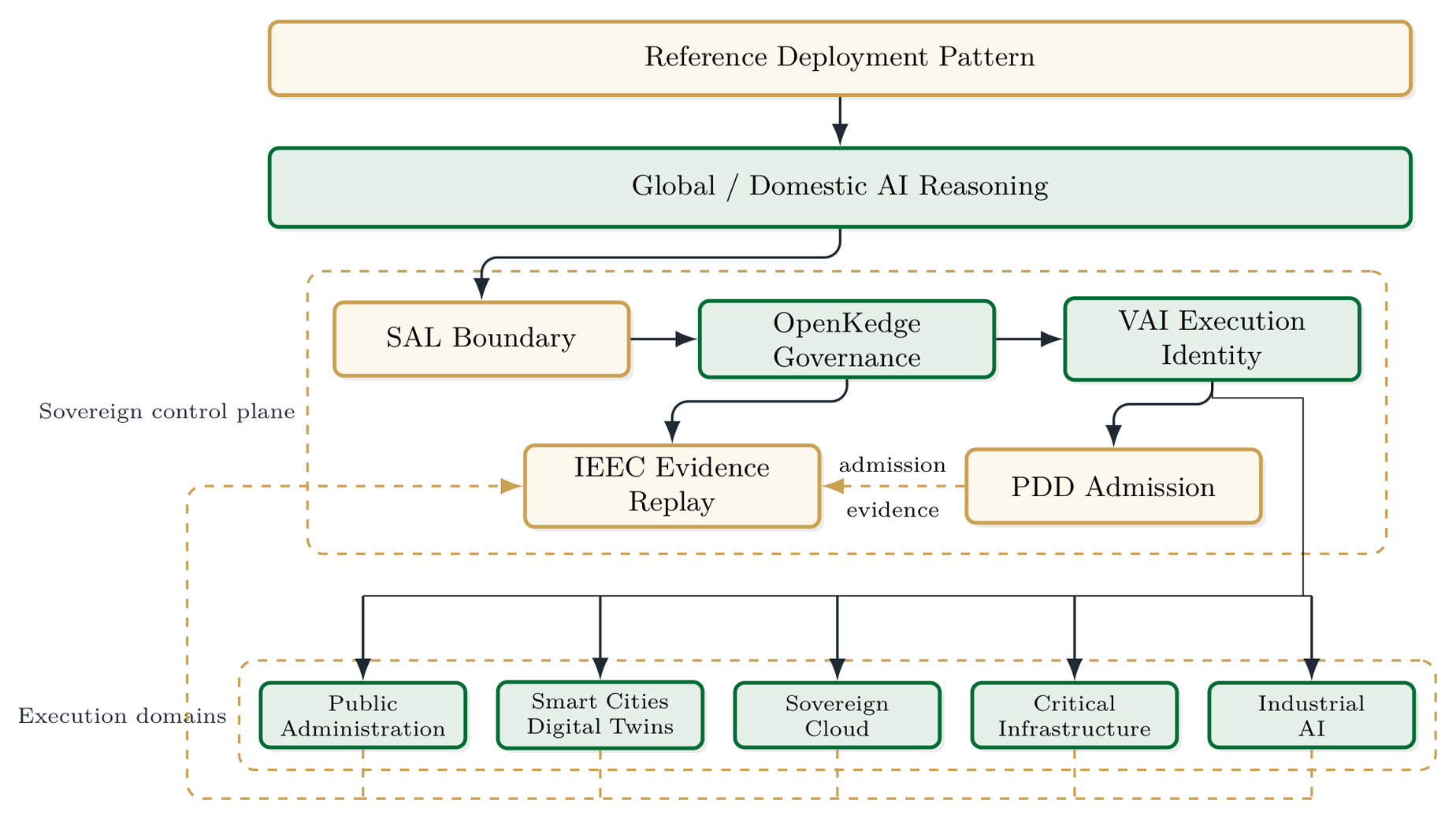
These layers form a decoupled governance system. Cognitive models, infrastructure providers, and policy syntax may change over time, but the sovereign control plane remains the stable boundary that prevents probabilistic reasoning from bypassing deterministic administrative control.
Pilot Program Roadmap
Deploying a national-scale governance architecture requires a staged, evidence-first approach starting with highly bounded pilot programs. These pilots test whether intent governance, cryptographic identities, tamper-evident records, and protocol-based software admission can operate reliably within actual institutional environments while keeping operational risk bounded.
| Pilot | Objective | Primary Control-Plane Mechanism |
|---|---|---|
| Public-service workflow | Accountable AI-assisted administration | Intent governance, escalation, evidence chain |
| Cloud remediation | Safe autonomous infrastructure operations | Execution contracts and proof-derived execution identity |
| Smart-city digital twin | Governed cyber-physical decision support | Simulation, approval, bounded execution |
| Generated-code admission | Safe use of AI-generated automation | Protocol-Driven Development and admission evidence |
A credible pilot program should evaluate metrics beyond processing speed or throughput. Useful indicators include policy compliance rates, false approval and denial indices, context freshness, average credential lifespans, policy explainability scores, and human operator trust. These indicators help determine whether the control plane improves security or merely introduces administrative friction.
Strategic Implications
The core strategic implication of this reference study is that sovereign AI depends heavily on control-plane ownership. Modern states can use a broad spectrum of cognitive technologies-including proprietary frontier systems, open-source models, and specialized agents-without relinquishing administrative authority. Sovereignty is maintained not by isolating local systems from external tools, but by inserting a deterministic control plane that governs how those tools interact with production networks.
This shift reframes the debate around technological sovereignty. The primary strategic asset is not the reasoning model, but the control plane that regulates how that model acts. Models produce probabilistic reasoning; the control plane produces deterministic authority. Execution generates telemetry; the evidence chain produces institutional accountability. Protocols verify software components, and replay systems drive continuous policy improvement.
For any state or regulated enterprise deploying autonomous AI in high-impact environments, the challenge is similar: connecting probabilistic reasoning models to deterministic physical and digital systems. Waiting for more capable models or relying only on post-execution log reviews is insufficient. Organizations need active governance infrastructure so automated actions are bounded, verified, replayable, and legally accountable.
The next chapter generalizes these case-study patterns into a staged, multi-phase deployment roadmap for organizations adopting the Autonomous State Control Plane.
References
- [1]Kingdom of Saudi Arabia. Saudi Vision 2030. 2016. Official Site
- [2]Saudi Data and AI Authority. Our Strategies and Initiatives. 2026. Official Site
- [3]HUMAIN. HUMAIN. 2026. Official Site
- [4]NEOM. NEOM. 2026. Official Site