Vision 2030 & Sovereignty
Enables Saudi ministries to deploy unstable, probabilistic large language models (LLMs) safely on secure data without risking structural outages in public services.
Every major infrastructure era has required engineers to confront instability. Distributed systems confront partial failure, inconsistent replicas, latency spikes, and network partitions. Cloud systems confront noisy neighbors, dependency failures, resource contention, and cascading outages. Security systems confront adversarial inputs and compromised assumptions. Autonomous AI systems introduce a new form of instability: probabilistic reasoning connected to tools that can affect real-world state.
The response is not to deny this instability or wait for perfect agents. It is to architect around it.
Resilience to the Unstable
The objective is not to eliminate uncertainty from AI reasoning. The objective is to ensure that uncertainty cannot directly mutate systems beyond governed authority.
Rather than striving for perfect reasoning stability, this architecture builds systems that remain stable, governable, and auditable even when the reasoning layer is probabilistic, context-limited, or wrong. This is the conceptual bridge between engineering realism and sovereign institutional confidence. Engineers must respect instability; institutions must build for resilience.
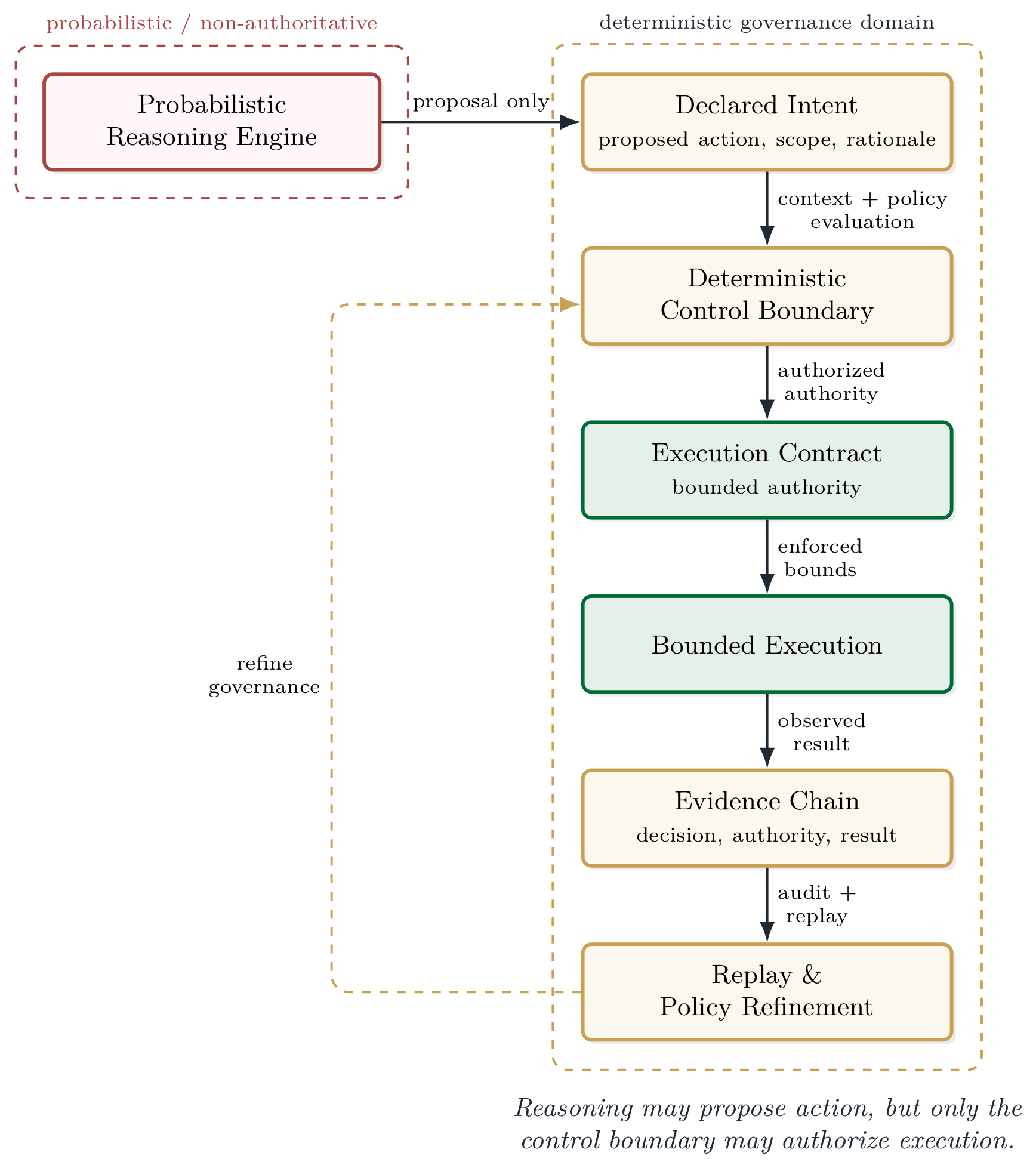
Figure 1 illustrates the central OpenKedge doctrine: AI reasoning engines may propose actions, but they do not directly possess execution authority. Authority is derived only after intent declaration, context evaluation, policy validation, contract generation, bounded execution, and evidence capture.
The New Instability
Traditional infrastructure is already built around instability. Hardware fails. Networks partition. Replicas diverge. Queues back up. Dependencies return partial results. Human operators make mistakes under pressure. Attackers manipulate inputs. Control planes drift from data planes. Production systems are never as clean as architecture diagrams.
Modern engineering disciplines emerged because these instabilities could not be wished away. Site reliability engineering, distributed systems design, zero trust architecture, chaos testing, incident response, and policy-as-code all share a basic assumption: systems must continue to behave within acceptable bounds when some part of the environment is uncertain, degraded, or adversarial.
Autonomous AI adds a different category of instability. An agent might reason from incomplete or stale context, interpret ambiguous instructions differently across runs, or produce a coherent-looking plan that harbors hidden operational mismatches. It might generate code or configuration that passes superficial checks while violating deep invariants, or offer plausible but incorrect justifications, following a non-repeatable reasoning path that cannot be reconstructed from the final answer alone.
The instability is not only that an AI model may produce an incorrect answer. The deeper risk is that its output is transformed into operational authority.
A generated answer remains information until it crosses into execution. A generated plan remains advisory until it becomes a tool sequence. A generated code patch remains a proposal until it is admitted into a build or deployment path. The risk changes when probabilistic reasoning is connected to systems that can mutate infrastructure, policy, money, data, software, public workflows, or physical operations.
The new instability therefore sits at the interface between reasoning and state. It is not enough to evaluate whether the model's text appears sensible. The architecture must determine whether the proposed action can be governed, bounded, enforced, evidenced, and replayed. The instability is manageable only if the system treats the reasoning layer as a source of proposals rather than a source of direct authority.
Respect the Unstable
Respect the Unstable is not a statement of fear. It is a statement of engineering discipline.
Respecting instability requires rejecting false assumptions. It demands that engineers verify agent accuracy, supply complete context, block direct mutation, refuse standing privilege, demand evidence for justifications, and never substitute confidence for control.
Respecting instability means designing boundaries around it.
This is familiar engineering logic. A distributed system does not assume the network is reliable. It uses timeouts, retries, consensus, idempotency, backpressure, and health checks. A secure system does not assume every request is benign. It validates identity, limits privilege, constrains access, monitors behavior, and preserves evidence. A cloud control plane does not assume every resource remains healthy. It observes, reconciles, rolls back, and limits blast radius.
Autonomous AI requires the same discipline. The reasoning layer may be powerful, but it is not a control boundary. A model's confidence, fluency, or internal chain of reasoning cannot replace policy evaluation. A tool call cannot replace authorization. A plausible explanation cannot replace evidence. A generated plan cannot replace an execution contract.
In control-system terms, autonomous reasoning should be treated as an input signal, not as the actuator itself. The signal may be useful. It may encode expert knowledge, strategic planning, translation, code synthesis, or rapid analysis. But the actuator that changes state must be constrained by a control system. The control system must decide whether the proposed change is admissible, what authority is justified, what conditions apply, and what evidence must be retained.
This also implies observability and reconciliation. A resilient AI control plane must be able to observe proposed intent, compare desired state with actual state, detect drift, and reconcile outcomes against policy. If execution diverges from the approved contract, the system should be able to stop, roll back, escalate, or record the deviation for replay. Instability is manageable when it is made visible and bounded.
Respecting the unstable reasoning layer does not make the architecture anti-AI. It makes the architecture fit for AI. Powerful reasoning can be used more confidently when the system is designed to absorb uncertainty without surrendering execution authority.
From Engineering Mantra to Institutional Doctrine
Respect the Unstable is the engineering mantra. Resilience to the Unstable is the institutional doctrine.
For engineers, the mantra means treating the AI agent as a non-deterministic reasoning component. Its output may be valuable, but it must be mediated. The agent proposes. The control plane evaluates. Execution occurs only through bounded authority. Evidence records what happened. Replay allows the institution to understand and improve the system.
For sovereign institutions, the doctrine is broader. Public systems, national infrastructure, regulated workflows, and strategic digital assets must remain stable even when AI reasoning is uncertain. A government platform cannot depend on every agent interpreting every instruction correctly. A critical infrastructure operator cannot rely on the assumption that every generated plan has full operational context. A regulated enterprise cannot treat a natural-language justification as a sufficient basis for state mutation.
A national AI system should rely on enforceable limits around agent authority, rather than assuming that every agent will reason correctly.
This is the institutional translation of engineering realism. The system may leverage frontier reasoning, specialized models, open-source models, domestic models, and external services. Yet institutional confidence comes from the deterministic controls that govern execution, not from a promise that reasoning will never fail.
The distinction also matters for accountability. When an autonomous system affects a high-consequence workflow, the institution must be able to answer what intent was proposed, what context was evaluated, what policy applied, what authority was granted, what action occurred, and what evidence supports the result. Institutional trust cannot rest on the model's explanation alone. It must rest on an evidence-backed control system.
Probabilistic Reasoning, Deterministic Governance
This white paper's architectural premise is simple: probabilistic reasoning should not directly produce deterministic state transitions.
Large language models and related AI systems operate by producing outputs under uncertainty. Their behavior can vary with prompts, retrieval state, conversation history, tool results, temperature, model version, provider behavior, system instructions, and hidden context. This does not make them unusable. It makes them different from the deterministic systems they are beginning to influence.
Infrastructure mutation requires deterministic governance. A production change either happens or does not. A credential is granted or denied. A workflow is approved, escalated, or rejected. A generated software component is admitted or excluded. A policy decision must be tied to identifiable context, policy version, scope, authority, and evidence.
Reasoning may be probabilistic, but execution must be governed.
The interface between these two worlds must be intent, not direct action. Intent is the structured expression of what the reasoning layer proposes to change and why. It gives the control plane something governable: objective, scope, target, expected effect, constraints, risk, context, and evidence requirements. Direct action bypasses this conversion and asks the execution environment to treat model output as operational command.
Rather than attempting to force reasoning to be deterministic, the control plane enforces deterministic execution authorization. Given an intent, current state, active policy, identity context, time, and evidence requirements, the governance decision is reproducible: approving, denying, escalating, simulating, or constraining the proposed action according to rules that can be inspected and improved.
The control plane does not assume that the reasoning layer is malicious. It assumes something more general and realistic: the reasoning layer is non-deterministic, context-limited, and external to the execution boundary.
The control plane requires enforceable boundaries, not perfect agents.
This framing avoids two inadequate extremes: overtrust, which assumes model adequacy, delegates tools, and relies on retrospective logs; and paralysis, which assumes models can never participate in critical workflows. The control-plane architecture enables a practical middle path: allowing models to reason and propose, while requiring deterministic governance before execution.
Containment Without Isolation
Resilience to the Unstable also sets up the sovereignty argument. Organizations and nations need not accept a false binary between fully trusting external frontier models and isolating themselves from global AI innovation by attempting to rebuild every capability domestically. Both options are incomplete.
The Autonomous State Control Plane establishes a third path: leveraging global intelligence while containing execution within sovereign, institutional boundaries.
Sovereign Control
Models may be global. Execution authority must remain sovereign.
A model may assist with reasoning, planning, translation, code generation, policy analysis, simulation, and operational triage. It may be domestic, foreign, open, proprietary, frontier-scale, or specialized. The architecture should be able to use that reasoning without granting the model direct control over infrastructure, citizen-facing workflows, financial state, regulated data, or critical operations.
Sovereignty is preserved by controlling policy, identity, execution, evidence, and audit. The critical factor is not where the model is hosted or who trained it, but whether the institution owns the deterministic boundary through which any model output becomes action.
Containment without isolation is therefore a positive architecture. It lets institutions use capable reasoning engines while preserving authority over state mutation. It supports model diversity without surrendering governance. It allows multi-cloud and sovereign cloud deployments to share a common principle: reasoning can be external, but execution authority must remain inside the control plane.
This chapter is not specific to any one nation, provider, or sector. The doctrine applies anywhere autonomous reasoning is connected to high-consequence systems. Later chapters develop this sovereignty boundary more directly, but the foundation is established here: resilience comes from controlling the interface between unstable reasoning and governed execution.
Control Boundaries for Autonomous Systems
The Autonomous State Control Plane introduces a set of control boundaries that convert unstable reasoning into governed state transitions. Each boundary targets a specific class of instability to contain it before execution.
The reasoning boundary prevents model output from becoming direct authority. External or internal models produce proposals, but those proposals must be converted into intent. Sovereign Agentic Loops and intent isolation make this boundary explicit.
The policy boundary decides whether an intent is acceptable under current conditions. It evaluates context, constraints, institutional rules, risk posture, and operational state. OpenKedge intent governance is the primary mechanism for this boundary.
The identity boundary binds runtime authority to validated intent. Instead of relying on standing privilege, the system derives execution identity from the approved intent, context, policy, and time. Verifiable Agentic Infrastructure develops this requirement into proof-derived execution identity.
The execution boundary limits what the system may actually do. Approved actions should execute only through bounded contracts that define scope, target, operations, time window, verification requirements, and evidence obligations.
The evidence boundary makes decisions and outcomes auditable and replayable. The system must record intent, context, policy decision, identity, execution, and verification events as part of the Intent-to-Execution Evidence Chain.
The protocol boundary governs generated software before admission. If an agent can generate code, configuration, policy, or system components, those artifacts must satisfy machine-enforceable invariants before they become part of the execution substrate. Protocol-Driven Development provides this admission model.
| Boundary | Purpose | Primary Mechanism |
|---|---|---|
| Reasoning boundary | Prevent model output from becoming direct authority | Sovereign Agentic Loops and intent isolation |
| Policy boundary | Decide whether an intent is acceptable under current conditions | OpenKedge policy evaluation |
| Identity boundary | Bind runtime authority to validated intent | Proof-derived execution identity |
| Execution boundary | Limit what the system may actually do | Bounded execution contracts |
| Evidence boundary | Make decisions and outcomes auditable and replayable | Intent-to-Execution Evidence Chain |
| Protocol boundary | Govern generated software before admission | Protocol-Driven Development invariants |
These boundaries do not remove uncertainty from AI reasoning. They prevent that uncertainty from crossing directly into uncontrolled execution. Later chapters develop these control boundaries through Sovereign Agentic Loops, OpenKedge intent governance, Verifiable Agentic Infrastructure, and Protocol-Driven Development.
Design Implications
Resilience to the Unstable produces practical design implications for any institution building autonomous AI systems.
Agents should propose, not directly execute. The architecture should require agents to produce structured intent before operational tools can mutate state.
Intent should be explicit and machine-readable. Natural-language instructions and explanations are useful for humans, but governance requires structured objectives, scopes, constraints, targets, expected effects, and evidence requirements.
Credentials should be task-scoped and time-bounded. Standing privilege is poorly matched to autonomous execution because it persists beyond the specific intent and can be reused across contexts.
Policy should evaluate runtime context. A decision that is safe in one operational state may be unsafe in another. Policy must account for current state, dependency, jurisdiction, risk, timing, and institutional constraints.
Evidence should be produced at every stage. The system must preserve the path from reasoning to intent, policy, identity, execution, verification, and outcome. Evidence-backed trust is stronger than explanation-backed trust.
Replay should be built in by design. Institutions must be able to reconstruct decisions, test policy changes, compare alternate outcomes, and improve controls without relying on memory or incomplete logs.
Generated code should be admitted by protocol, not trust. AI-generated software may be useful, but usefulness is not admission. Generated artifacts must satisfy structural, behavioral, and operational invariants before they become part of the system.
Control planes should be sovereign, portable, and vendor-neutral. The governance boundary should not depend on a single model provider, cloud provider, tool framework, or deployment environment. Institutions should be able to change models and infrastructure while preserving deterministic control over execution.
The operational test is straightforward: when the model, prompt, tool chain, or infrastructure substrate changes, the institution should not lose control over policy, identity, execution, evidence, or replay. Resilience is achieved when the system can absorb change in the reasoning layer while preserving the authority and accountability of the control plane.
These implications do not reduce the ambition of autonomous AI. They make serious autonomy possible. Resilience to the Unstable is not a defensive posture. It is the operating principle for building AI systems that can safely use powerful reasoning engines without surrendering control over execution.